

The Noakhailla people (Noakhailla: Noya-khailla, IPA: [noa-khailla])
are an Indo-Aryan ethno-cultural group originating from and culturally associated
with
the historical region of Noakhali, Southern Tripura, Northern
Chittagong in southeastern Bangladesh. As a
distinct coastal population with deep historical roots in the ancient regions of
Samatata and Bhulua, the Noakhailla people possess a unique
cultural
identity, language, and social heritage that differentiate them from other
Bangladeshi communities. Today, their population is primarily concentrated in
the
Bangladeshi districts of Noakhali, Feni, Lakshmipur, Northern Chittagong, and parts
of southern Tripura
in
India, with growing diaspora communities in the Middle East, the United Kingdom, and
North America. Most Noakhaillas speak the Noakhailla language,
recognized by the ISO 639-3 code oak, which belongs to the Eastern
Indo-Aryan branch and exhibits distinct phonological and grammatical features,
including
tonal elements..
The Noakhailla People: An Ethno-Cultural Identity Rooted in History, Language, and Culture
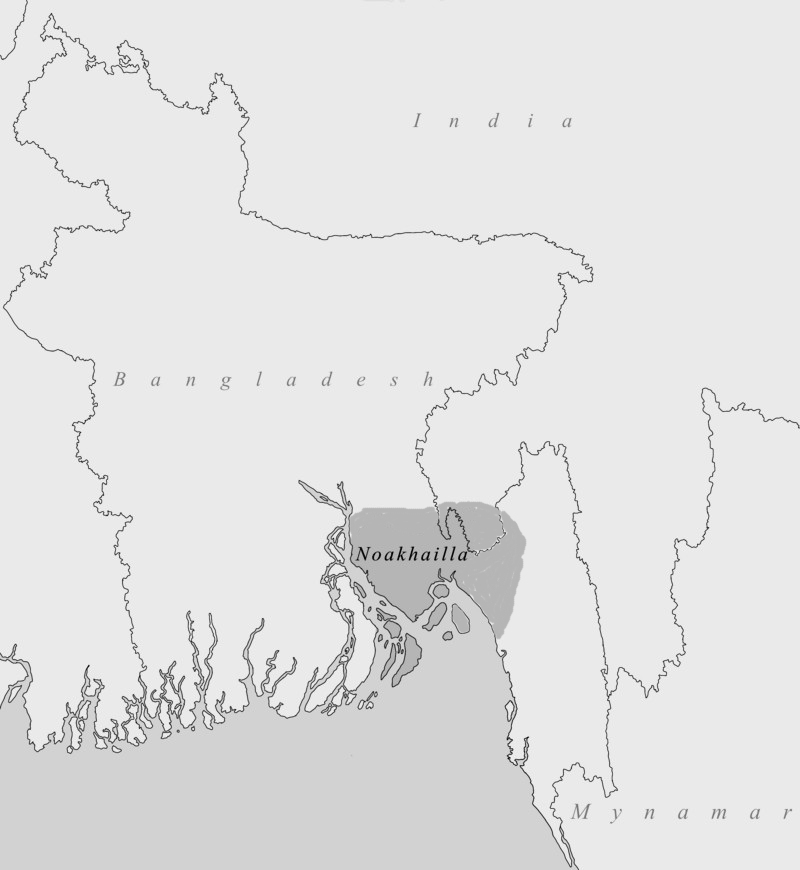 Map of Noakhailla speaking areas of South Asia
| Total population | c. 14-20 million |
| Regions with significant populations | |
| Bangladesh |
Noakhali, Feni, Lakshmipur, Southern
Comilla,
Northern Chittagong |
| India | South Tripura, and some parts of
Assam |
Middle East | GCC countries (UAE, Saudi Arabia,
Qatar) |
| Western world | UK, USA,
Canada, Italy, Portugal |
| Populations |
16 million - 20 million |
| Religion |
Predominantly: Islam Minority: Hinduism, Christianity and Buddhism |
| Related ethnic groups |
Indo-Aryan
peoples Sylhetis |
Language: The Core of Ethnic Identity
The most defining characteristic of the Noakhailla people is their language, Noakhailla (also called Noakhali), which is an Indo-Aryan language spoken natively in the Noakhali region, parts of Feni, Lakshmipur, and southern Tripura. Although often misclassified as a dialect of Bengali, Noakhailla is linguistically unique, showing tonal features and an independent grammatical structure. It is also not fully mutually intelligible with Bengali, as Bengali speakers generally require prior exposure to understand it, further underscoring Noakhailla's distinct identity as a language.
With its own ISO 639-3 code (oak), the Noakhailla language is formally
recognized,
further
establishing the group's
distinct ethno-cultural identity. The language also includes vocabulary from
Arabic, Persian,
and
Sanskrit, a reflection
of centuries of cultural interaction.
Culture and Customs
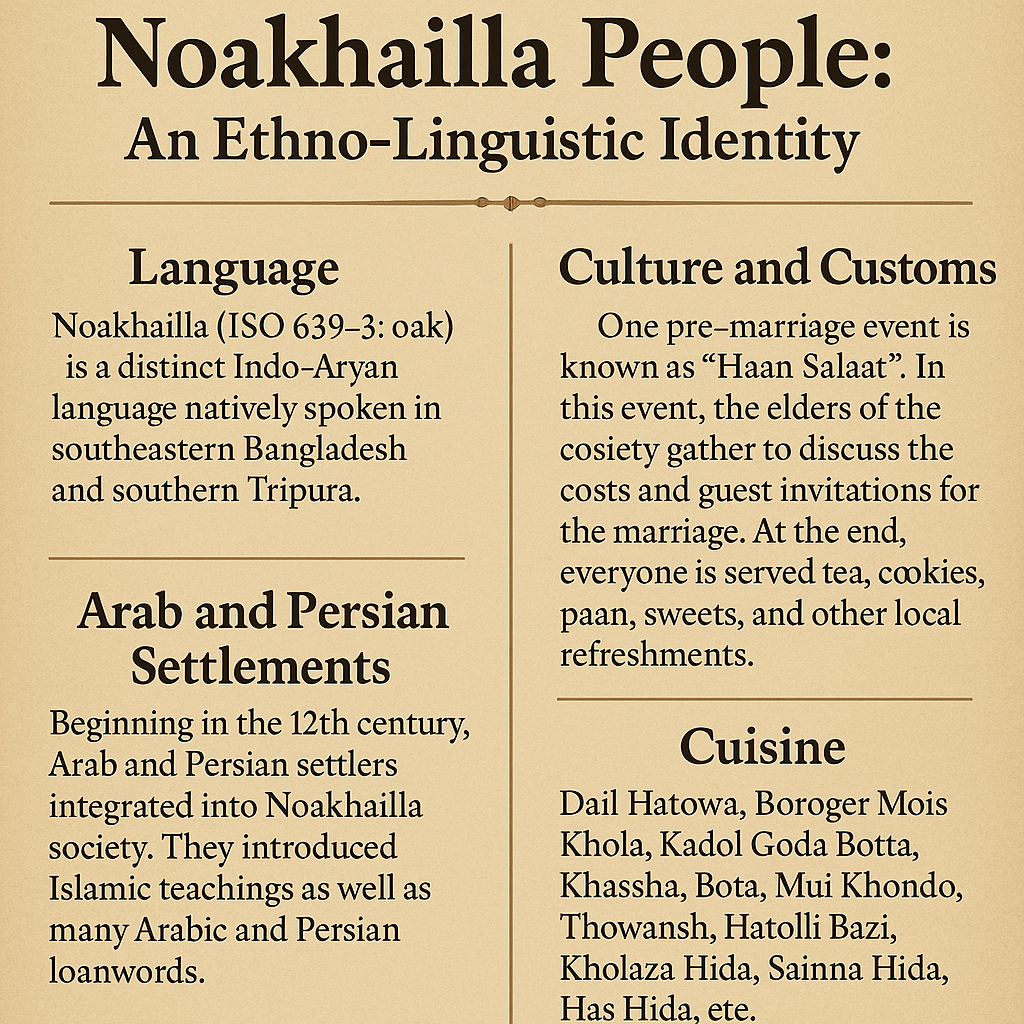
Noakhailla culture is rich in tradition, emphasizing community, kinship, and social harmony. One of the most unique customs is "Haan Salaat",In this event, the elders of the society gather to discuss the costs and guest invitations for the marriage. At the end, everyone is served tea, cookies, paan, sweets, and other local refreshments.
Other culturally specific events include Maira Deya (gift exchange), Biya Barat (wedding procession), and Utshob Ghor (post-wedding celebration), each showcasing Noakhailla songs, attire, and ceremonial etiquette distinct from other Bangladeshi groups.
Culinary Traditions: A Taste of the Delta
The cuisine of the Noakhailla people is diverse, flavorful, and closely tied to the coastal environment. Some notable dishes include:
- Dail Hatowa
- Boroger Mois Khola
- Kadol Goda Botta
- Khaissha
- Bota
- Mui Khondo
- Thowansh
- Traditional stews with duck, beef, or chicken
- Hatolli Bazi
- Kholaza Hida
- Sainna Hida
- Has Hida
Historical Roots: From Samatata to Bhulua
The roots of the Noakhailla people trace back to the ancient coastal kingdom of Samatata, an independent polity during the Gupta and post-Gupta periods. Later, the region became part of Harikela and eventually transformed into the medieval Bhulua Kingdom, which played a major role in shaping the identity of the Noakhailla people.
Unlike the central Vanga region, Noakhailla developed in relative isolation, fostering its own traditions, linguistic features, and social structure. The influence of successive local rulers, combined with Muslim governance, helped cultivate a distinct cultural path.
Arab and Persian Settlements: Cultural & Genetic Legacy
From the 12th century onwards, the coastal areas of today's Bangladesh especially Samatata and Bhulua-saw the arrival of Arab traders, Persian scholars, and Sufi saints. Many of these settlers integrated into local society, marrying into the population and spreading Islamic teachings and cultural values.
This resulted in a significant Arab-Persian imprint on Noakhailla society. Arabic words like dua, noz(namax), and zokat(zakat), and Persian-origin terms like kagoz (paper), and hoir (ascetic) became common. Religious rituals, titles (e.g., mulisa, mosoid), and architectural styles also reflect these influences.
Genetically and socially, these settlements contributed to the shaping of the Noakhailla people as a coastal Muslim society with a hybridized South Asian and Middle Eastern heritage-evident in both cultural practices and local oral traditions that speak of "Arab er Bachcha" (descendants of Arabs) in some areas.
Modern Identity and Recognition
The Noakhailla people, with an estimated population of 16 to 20 million, remain
one of the most prominent yet underrepresented ethno-cultural groups in South Asia. While
their cultural and linguistic roots are deeply embedded in southeastern Bangladesh and parts of
southern Tripura, sizeable diaspora communities have also formed across the Middle East, the
United Kingdom, and North America. In recent years, increased cultural awareness, community-led
revival efforts, and the official recognition of the Noakhailla language under ISO code
oak have contributed to a renewed acknowledgment of their distinct identity on both
national and international platforms.
With increasing academic research and community-driven digital projects, Noakhailla culture and language are gaining visibility and respect both nationally and internationally.
Conclusion
The Noakhailla people are more than just a regional community-they are a distinct ethno-cultural group with their own language, culture, food, and history. Rooted in the ancient Samatata region and shaped by centuries of intercultural exchange, including Arab and Persian influences, the Noakhailla identity stands proudly as a vibrant part of South Asia's diversity. Recognizing and preserving this heritage is essential for ensuring the survival of this unique cultural legacy.